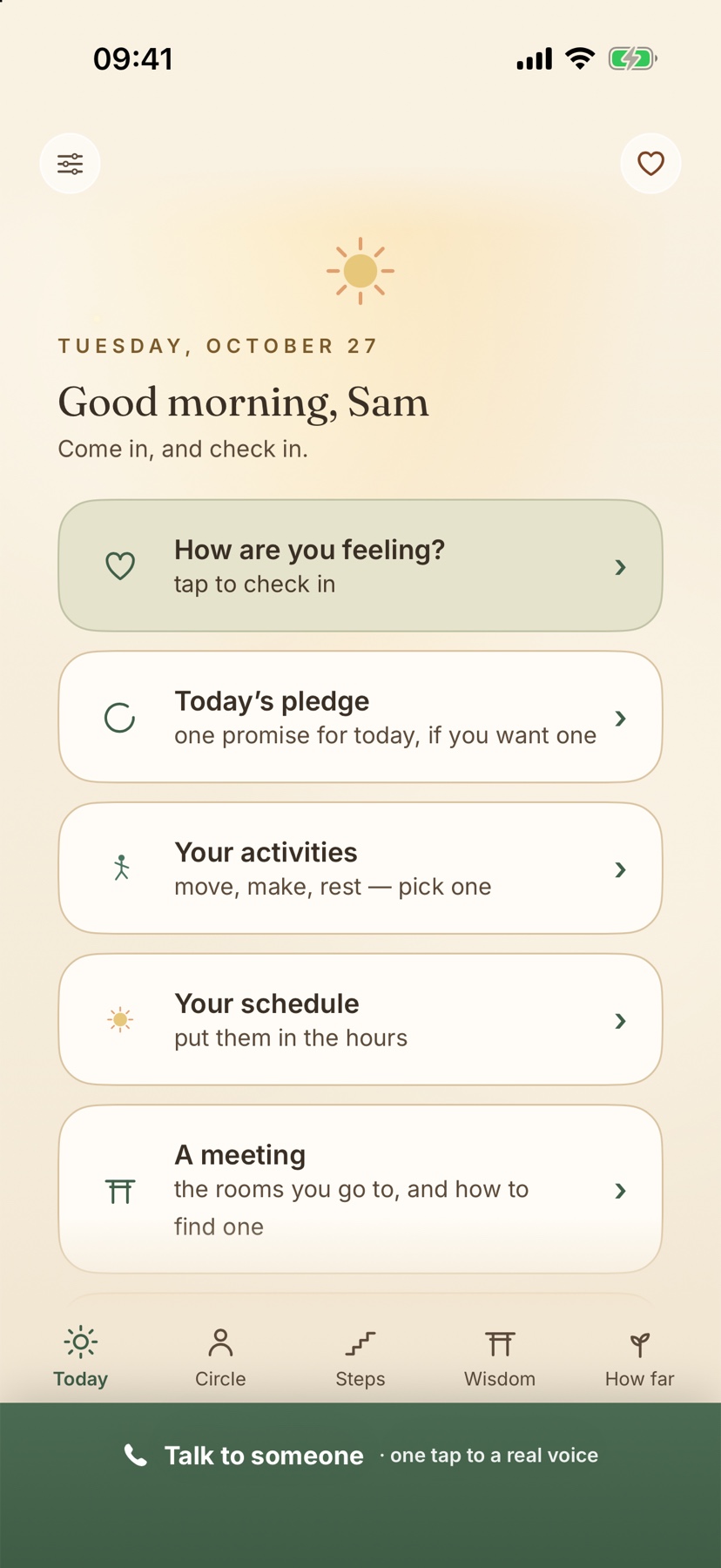
Today
The day, and the people in it
How you feel, a promise for the day, something to do with an empty hour, and the day laid out hour by hour.
Need someone now? Find a free, confidential helpline at findahelpline.com.
For treatment centers
Your program ends on a fixed day. What follows is long, quiet and mostly unattended, and it is the stretch in which many of your patients struggle. ASHA PATH is company for that stretch, and it is part of the onboarding your patient has already paid you for: your center holds the licenses, and nothing extra is ever charged to them.
One place for the hours your program no longer covers: the day laid out hour by hour, a check-in that keeps its own history, seven stages walked at the patient’s pace, and a lifeline on every screen reaching four people they chose and the US crisis lines. It holds that shape for months and asks nothing of your center after the handover.
Given to patients by treatment centers · iPhone and Android · no purchases inside it, no advertising, no data collected
If you need someone now please reach a person rather than a page.
Find a free, confidential helpline in your country at findahelpline.com, and call your local emergency number in immediate danger.
What it is
Six screens, and the lifeline sits at the foot of every one of them. It is an adjunct to your program and a substitute for no part of it: every door in it leads back to a person, and the first one is your center.
Today
How you feel, a promise for the day, something to do with an empty hour, and the day laid out hour by hour.
The lifeline
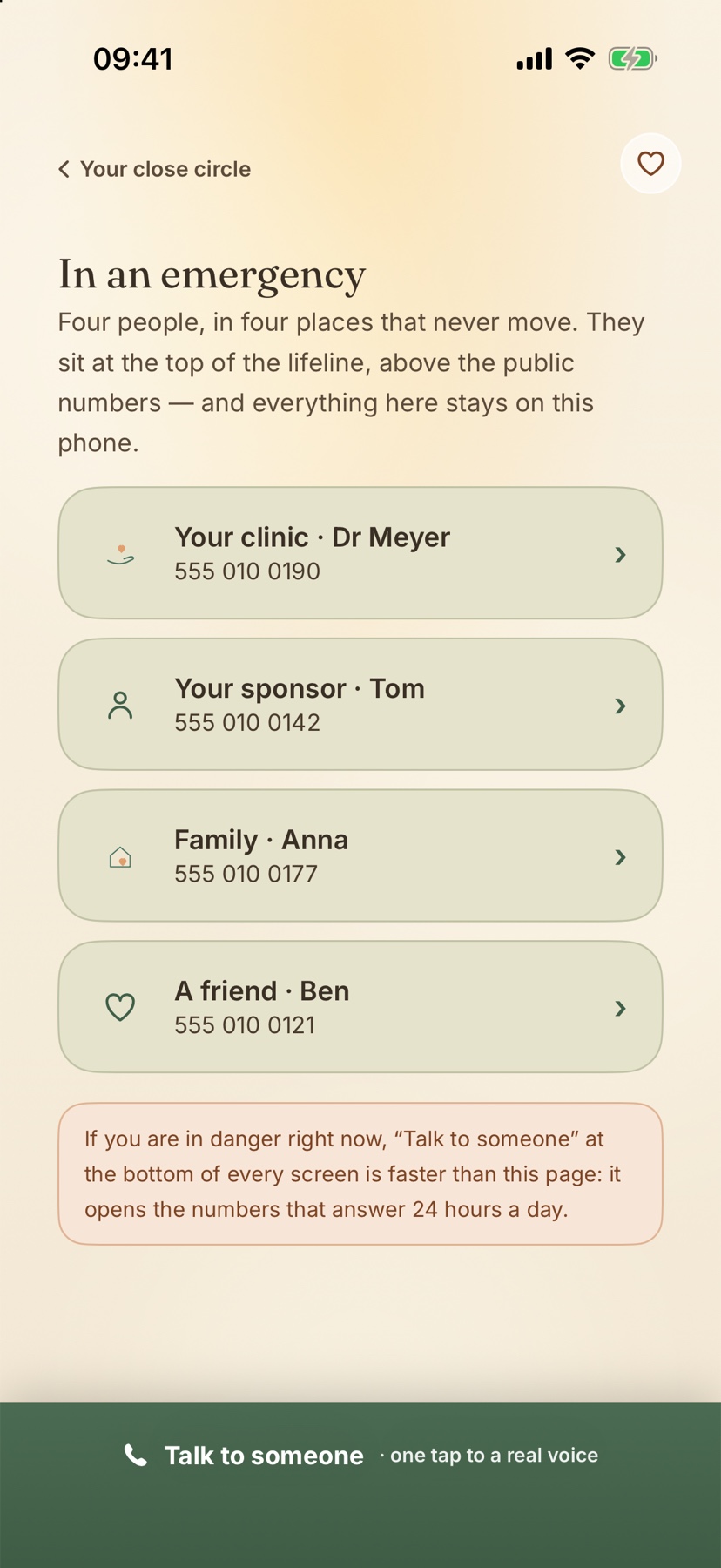
A band at the foot of every screen, opening four people the patient chose. Never behind the app lock.
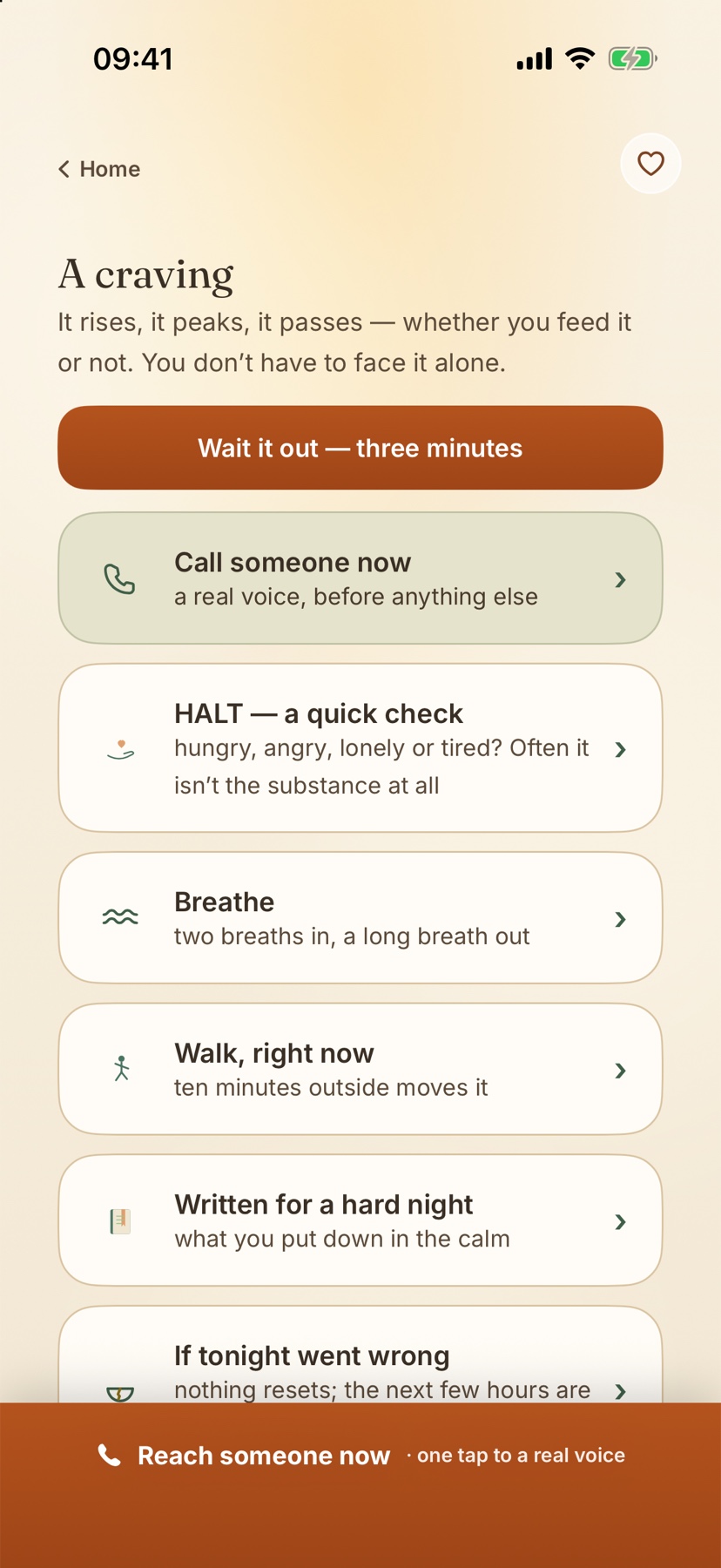
When it is hard
Wait out three minutes with a breath to follow, run a quick HALT check, or call someone.
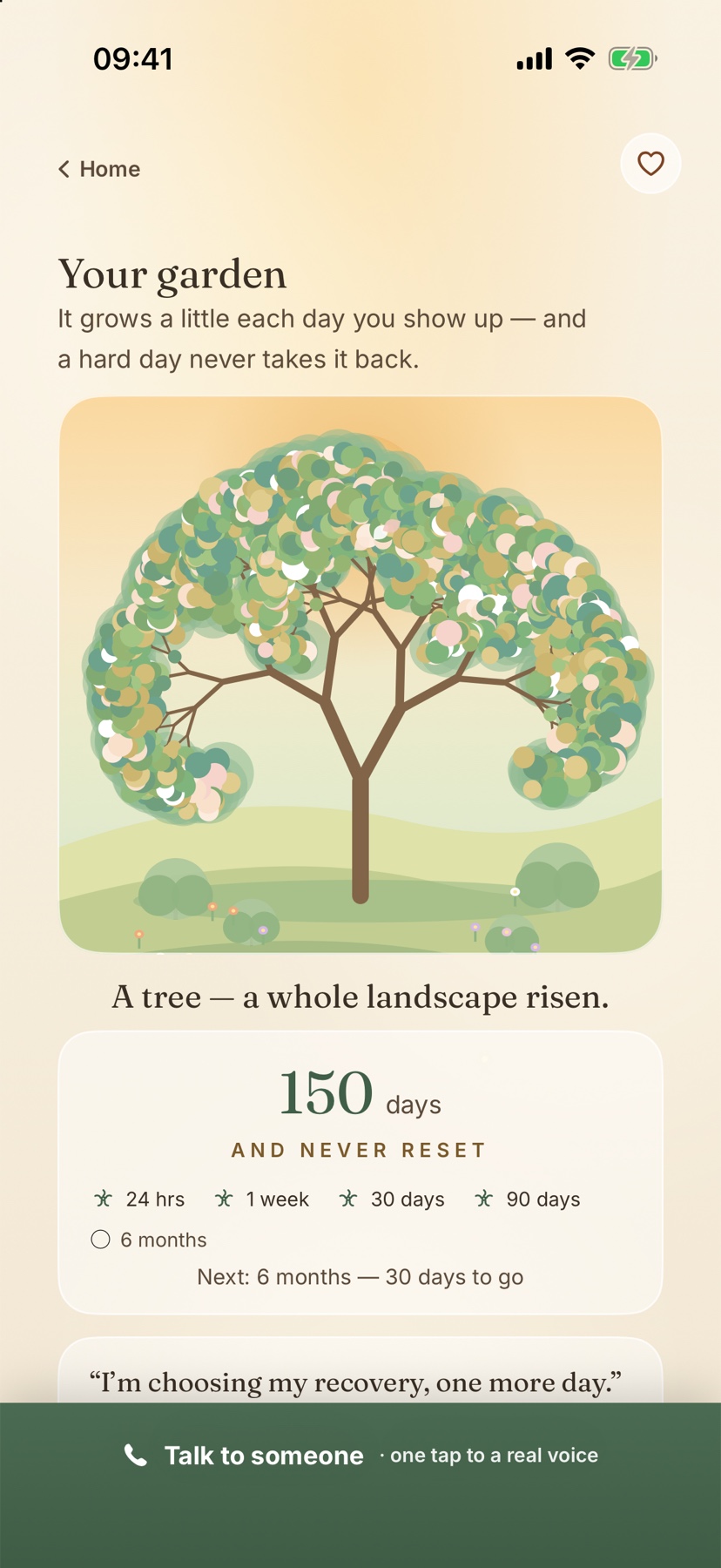
The garden
It grows with the days shown up for and never resets. A hard day takes nothing back.
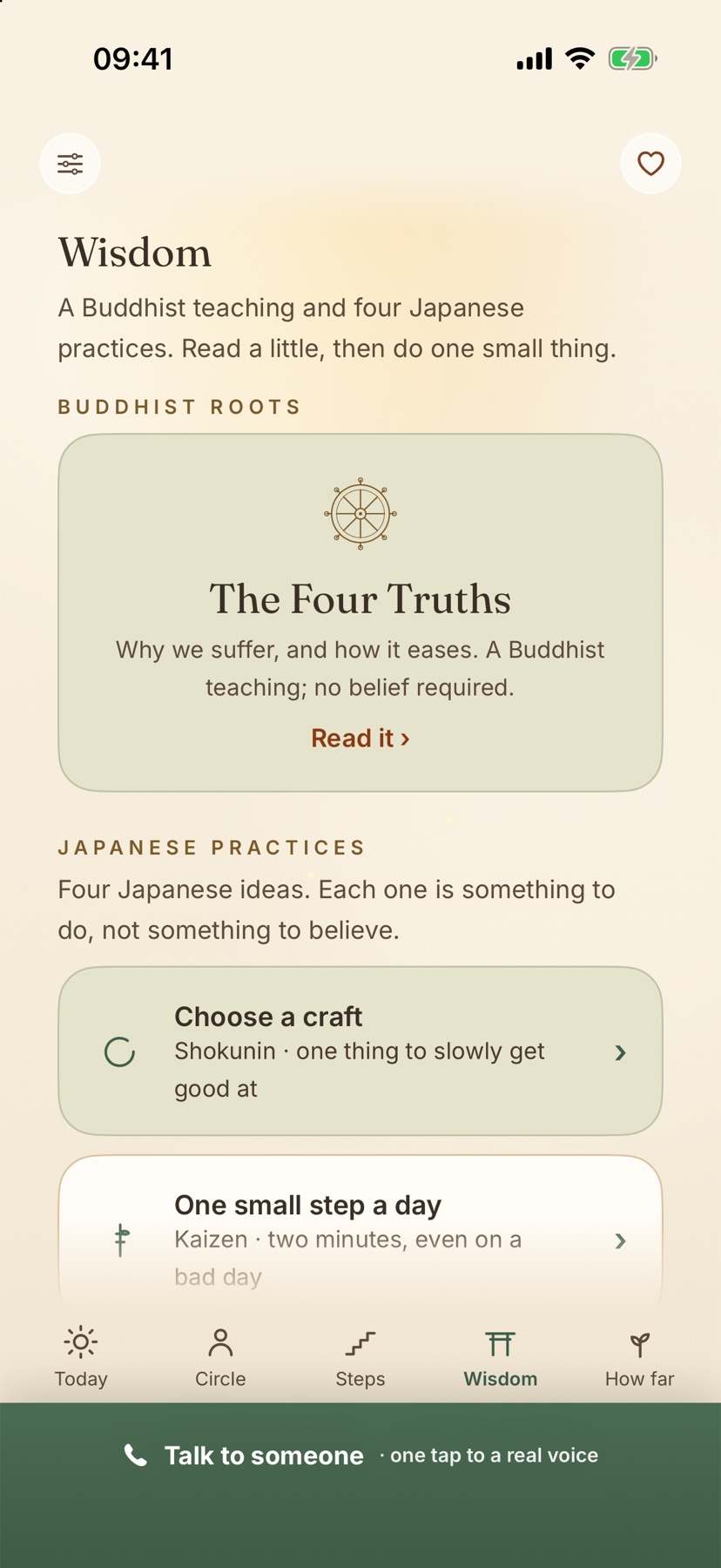
Wisdom
A Buddhist teaching in the app's own words, and four Japanese practices. No belief required.
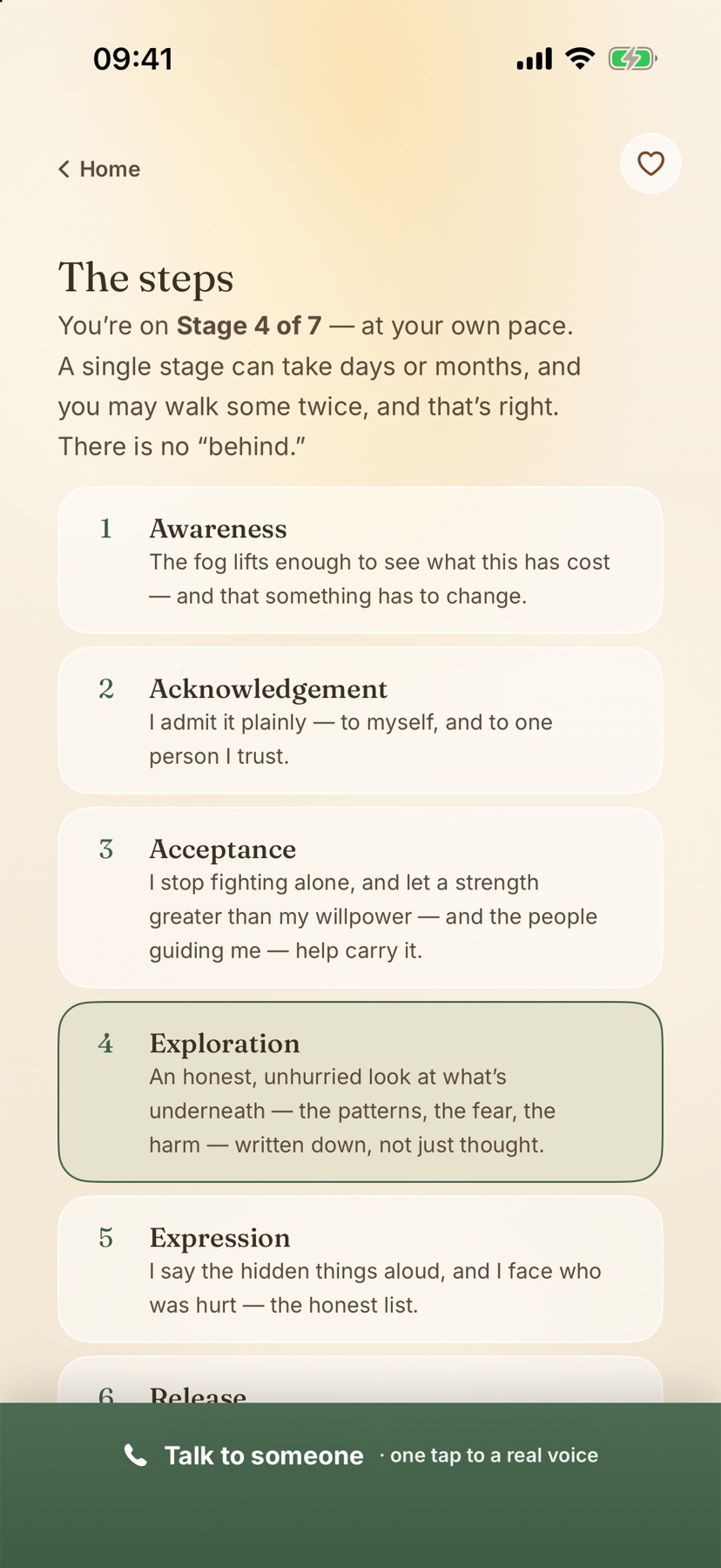
The steps
Seven stages at your own pace, offered as an introduction and plainly not as the Twelve.
Discharge day
It carries the app and your center’s code. No account to create, no license to assign, nothing for your team to administer, and nothing to renew.
Your name and your center’s number go to the top of the lifeline, above the public helplines. The code is optional: the app works in full without it.
There is nothing to monitor and nothing to chase. The app asks you for nothing after the day they leave, because it cannot reach you.
Adults, 18 and over. It is neither designed for nor offered to minors, and it is given to patients by treatment centers rather than sold to the public.
Privacy
There is no account and no login, and every part of the app works on first launch. There is no analytics, no advertising identifier and no server to send anything to. The app carries no networking code of any kind: no requests, no sockets, no web view, nothing written that could reach out. There is nothing to switch off, because there is nothing there.
Every category of the App Store privacy declaration is answered Data Not Collected. It is a claim about an app that contains no networking code at all, so it can be checked rather than taken on trust.
An optional passcode or Face ID, off by default. The lifeline stays reachable from the lock screen, without the code.
The numbers
The lifeline carries the national lines a patient needs where they are, chosen by the phone's own region with no geolocation and no location permission. It is never behind the app lock.
A patient who names gambling also gets the National Problem Gambling Helpline. Every number is read on the issuing organization's own page before it ships. A patient who travels finds verified lines for six other countries, and findahelpline.com everywhere else.
Evidence
One trial has tested a smartphone companion given to patients leaving residential treatment, and it is the nearest thing to this product that has been measured. We did not run it, and we are not borrowing its result.
Three things we would rather say first. That trial is not this app: A-CHESS carried staffed peer support, a moderated community and contingency management, and it is sold today as CHESS Health’s Connections. No trial of ASHA PATH exists, and if that disqualifies us for your program it should. And the dose-response finding in that trial was post hoc, not its design.
Figures read at source, 29 October 2026: the JAMA Psychiatry author manuscript and the Cochrane review’s own summary. The app itself cites none of this. It gives no medical advice; the one study it names is a breathing trial (Balban and colleagues, Stanford, 2023), and the one figure it quotes is A.A.’s own.
Honest about what it is
ASHA PATH is not a medical device. It makes no diagnosis, gives no treatment, no medication or dosing guidance, and no medical claims. It teaches practices; it does not advise. Its promise is smaller and real: when a moment turns dangerous, a real voice is one tap away, and always free.
What is not verified. No patient has used it. There is no efficacy data and no study. We would rather say so before we are asked.
The arrangement
Your patient pays your program, as they already do, and this is part of what that buys. Your center holds an annual license for an agreed number of discharging patients, invoiced directly: no app store in the middle, no payment platform taking a cut, and no transaction between us and your patient at any point. We never pay a center per patient, in either direction, which is what keeps the arrangement clean. Licensing is the whole of the business model: no subscription, no purchases inside it, no advertising, and no data to sell.
No dashboard, no engagement data, no adherence figure. Someone who suspects the clinic is reading their journal will not write in it. If reporting is a requirement of your program, this is the wrong tool, and we would rather say so now.
Structured help getting to a sponsor and a meeting, in plain language. The fellowships' own finders are one tap away; the app fetches, stores and invents no meeting data of its own.